What if every building became a power plant?
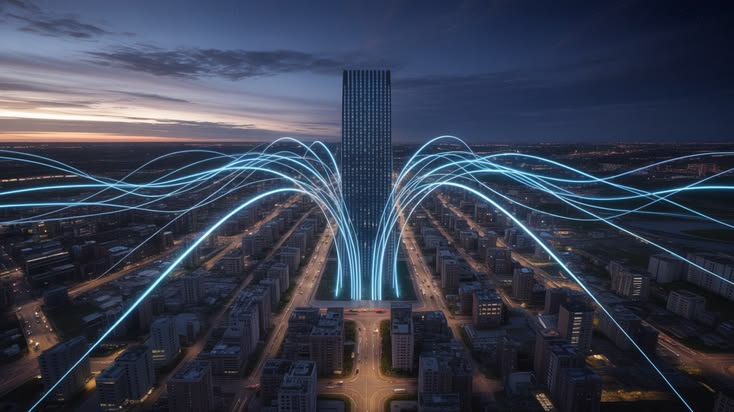
For a century, energy flowed one direction: from central plants through transmission to consumers. That model is ending. Today, rooftop solar, batteries, EVs, and smart controls turn individual sites into active grid participants. They generate, store, and respond to real-time signals. The passive endpoint has become an intelligent node.
This creates a new challenge: how do you orchestrate a grid where every building has decision-making capacity and those decisions must align with overall system health? The answer is edge intelligence-distributed computing at the point of consumption and generation, coordinated by a centralized layer. This is the grid edge revolution.
Why the shift is accelerating
Three converging forces are reshaping energy systems faster than traditional timelines allow.
Economics. Battery costs have fallen 90% in a decade. Solar is now cost-competitive with centralized generation in most markets. Behind-the-meter deployments are accelerating beyond utility forecasts.
Resilience. Centralized grids have single points of failure. Distributed systems operate in islands, maintaining power during transmission disruptions. As climate volatility increases, resilience has become non-negotiable.
Electrification strain. EV charging, heat pumps, and expanded cooling loads create demand spikes that aging infrastructure cannot handle. Local generation and storage at the edge avoid massive transmission upgrades.
From consumption to coordination
Traditional operations assumed stable, predictable demand. In distributed grids, demand itself becomes active and responsive. Smart thermostats adjust based on real-time signals. EV charging pauses during stress. Batteries discharge to help peak periods. This responsiveness requires visibility across thousands or millions of assets in real time-computationally intensive and operationally new. Organizations succeeding here invest in advanced grid analytics and managed services that enable visibility and automated coordination. Without this, distributed energy becomes a coordination nightmare rather than an advantage.
Microgrids prove the model works
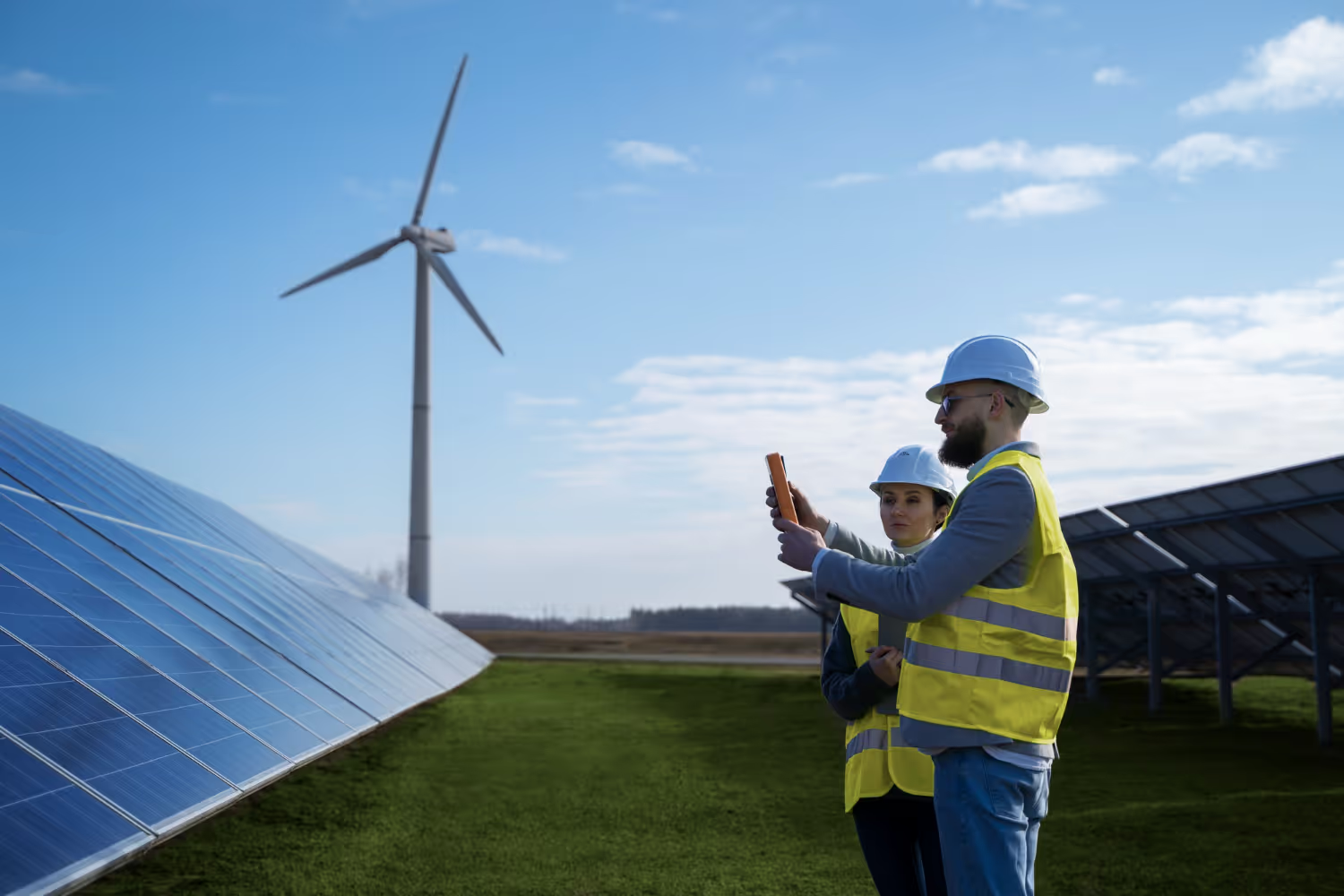
Utilities are testing distributed approaches at a smaller scale through microgrids- bounded networks serving neighborhoods, campuses, or industrial sites that operate connected to or independent from the main grid. Microgrids include local generation (solar, wind), storage, and smart controls coordinating these resources to meet demand efficiently. They improve resilience, reduce transmission losses, and integrate renewables effectively. Critical facilities like hospitals are deploying them to ensure continuity during broader disruptions.
What microgrids demonstrate is that distributed complexity is manageable with the right architecture and visibility. That lesson now scales to the broader grid.
The data architecture challenge
Distributed grids generate orders of magnitude more data than centralized systems. Every solar inverter, home battery, and EV charger reports status and intentions. Decisions must happen in milliseconds, not hours. This requires shifting from centralized data warehouses to distributed edge computing, where local nodes process their own data and aggregate critical insights upward. Most utilities haven't built this architecture. Implementing enterprise data infrastructure that scales without creating silos or losing visibility is complex - it's not just technology, but designing systems that remain usable as complexity grows.
Where systems break
The biggest challenges in grid edge transition are architectural, not technical.
Device diversity. Distributed resources speak different languages. Tesla batteries differ from Generac systems, which differ from community solar. Effective coordination requires middleware and systems integration across heterogeneous devices.
Governance gaps. Who controls edge resources? The customer? The utility? Regulators? Virtual power plant frameworks are emerging where customers opt into coordinated control, but governance remains fragmented in many markets.
Cybersecurity exposure. Every distributed resource is an attack surface. Compromised inverters threaten grid stability. Continuous cybersecurity operations become critical as attack surface expands exponentially.
Legacy coexistence. Most utilities still operate significant centralized generation. New models must integrate with legacy systems for years, creating substantial hybrid complexity.
Utilities become orchestrators
This transformation redefines utility roles fundamentally. Historically, utilities generated and distributed power. In a grid edge world, they coordinate distributed assets, broker energy transactions, and operate systems orchestrated by algorithms and real-time signals rather than human operators. This requires new capabilities: real-time optimization across distributed resources, local energy trading mechanisms, automated system response, predictive maintenance across assets, and security that assumes breach rather than prevention. Organizations investing in these capabilities through technology transformation and managed services position themselves as intelligent coordinators of the energy future. Those preserving the old model lose relevance.
The choice: resist or evolve
Utilities face two paths in distributed energy transition.
Resistance - treating edge resources as threats and preserving centralized models- is economically untenable and increasingly unpopular.
Evolution - investing to orchestrate distributed complexity and capture value as intelligent coordinators, is proving profitable. Early movers create new revenue streams in energy management, demand flexibility, and local optimization.
Organizations thriving will manage visibility across distributed assets, make real-time decisions from edge data, integrate legacy and new systems, operate assuming continuous cyberattacks, and adapt quickly to regulatory and customer shifts. This requires comprehensive managed services, systems integration, and organizational transformation.
The grid's next decade
The distributed energy revolution is underway: virtual power plants in Australia, community microgrids in the US, peer-to-peer trading in Europe. Isolated pilots become operational baseline. The next decade's grid won't be defined by generation capacity, but by intelligent coordination of distributed resources. Success belongs to those who think local while optimizing at scale. The most successful energy organizations will transform from power suppliers into orchestrators, operating systems that are fundamentally distributed, resilient, and responsive.